
Burnout Is Not a Personal Failure. It Is a Leadership System Design Issue.
For years, organisations have responded to burnout, particularly among senior women, with resilience training, wellbeing initiatives, and advice to “set better boundaries”.
And yet the same patterns persist:
- high-performing women exiting leadership
- chronic exhaustion normalised
- inclusion and retention efforts stalling
That tells us something important. The issue is not individual capacity. It is the leadership systems people are being asked to operate within.
The Limits of Existing Leadership Models
Most contemporary leadership frameworks continue to over-reward:
- endurance
- pace
- control
- constant availability
While consistently undervaluing:
- regulation
- relational intelligence
- judgement under pressure
- leadership longevity
Emotional Intelligence was an important step forward. It expanded how leaders understood behaviour, relationships, and performance. But in practice, it largely asked individuals to develop new capabilities inside leadership systems that did not fundamentally change. The system remained the same. The burden shifted to the individual.
Burnout as a Predictable System Outcome
Today, burnout and psychological harm are increasingly recognised as psychosocial risks arising from how work and leadership are designed, not as personal weakness.
When leadership expectations consistently exceed human capacity, burnout is not an anomaly. It is a predictable outcome. This is not a women’s issue. It is a system design issue.

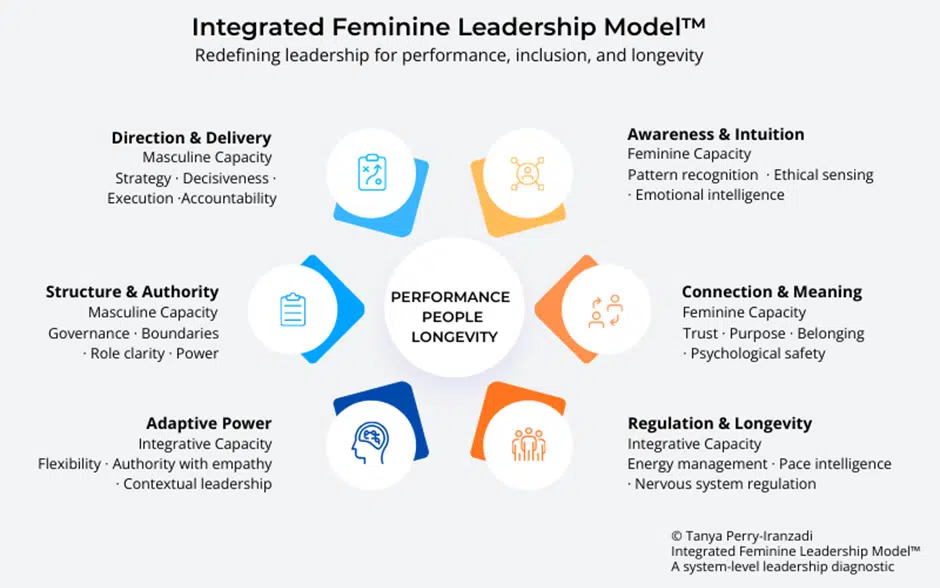
Introducing the Integrated Feminine Leadership Model™
The Integrated Feminine Leadership Model™ is a proprietary leadership system framework designed to address burnout, psychosocial risk, and leadership attrition at their source, the way leadership is defined, structured, and sustained.
The model integrates three core leadership capacities:
Directive capacity: Direction, authority, accountability, and delivery
Relational capacity: Awareness, connection, ethical sensing, and influence
Regulatory & adaptive capacity: Pace, regulation, judgement, and leadership longevity
These capacities are not gendered. They can exist in all leaders. The issue is not who can access them, but which capacities leadership systems consistently reward and promote.
Why This Matters Now: AI, Complexity, and Adaptive Power
As environments become more complex, accelerated by AI, technological change, and constant disruption, leadership systems that rely solely on control, speed, and output begin to fail.
In contrast, leadership systems that integrate:
- relational intelligence
- adaptive judgement
- system-level sense-making
- consistently outperform over time
In the era of AI, leadership advantage is no longer about having more information. It is about:
- interpreting complexity
- making sound decisions under uncertainty
- exercising judgement where prediction fails
This is adaptive leadership power, and it cannot be bolted on as a skill. It must be designed into the leadership system itself.

How the Model Is Applied
The Integrated Feminine Leadership Model™ operates across three interconnected levels:
Organisation level Leadership frameworks, expectations, pace, authority, governance, and psychosocial risk
Team level How leadership is enacted in practice, decision-making, pressure, relational load, and adaptive capacity
Individual level The capacity, regulation, and understanding of self required to lead sustainably within complex systems.
Leadership longevity outcomes are achieved when all three levels are aligned, when leadership systems are intentionally designed, teams are supported to operate under pressure, and individuals have the capacity to lead without depletion.
What This Model Is and Is Not
This is not a wellbeing framework. It is not a women’s initiative. And it is not Emotional Intelligence 2.0.
It is a leadership system diagnostic and design framework, intended to be applied with context, expertise, and organisational strategy.
This work does not ask women to adapt to systems that exhaust them. It asks organisations to redesign leadership systems so performance, inclusion, and leadership longevity can coexist.
That is what true inclusion looks like.
Why Capacities Are Described as Feminine
When this model refers to feminine leadership capacity, it is not referring to gender.
It refers to a set of system functions that have historically been under-recognised, under-valued, or carried invisibly, particularly by women but not only by women within leadership systems.
Capacities such as connection, meaning-making, awareness, and intuition are described as feminine because they are fundamentally relational and integrative in nature. They enable leaders to sense what is emerging in complex systems, understand impact beyond immediate metrics, and make judgements that account for people, context, and consequence not just output.
These capacities become essential when:
- information is incomplete
- conditions are uncertain
- decisions carry human and ethical weight
- linear cause–effect thinking no longer holds
In many organisations, these functions have been relied upon informally often expected of women leaders without being explicitly named, rewarded, or designed into leadership roles. The result has been disproportionate emotional and relational load, and an invisible drain on leadership capacity.
The Integrated Feminine Leadership Model™ does not ask leaders to “be more feminine”. It makes visible the leadership capacities required for modern complexity and integrates them deliberately alongside directive authority, delivery, and accountability.
When leadership systems recognise and value these capacities explicitly, they move from relying on individuals to compensate to designing leadership that can be sustained.

The Integrated Feminine Leadership Model™ functions as a leadership system diagnostic, enabling organisations to identify where leadership expectations, pace, authority, and relational load are misaligned with human capacity.
Rather than focusing on individual behaviour in isolation, the diagnostic examines how leadership is defined, rewarded, and sustained across the organisation, revealing the structural conditions that give rise to burnout, disengagement, and attrition.
Used well, it provides a clear basis for leadership system redesign not remediation.
Closing
Leadership longevity matters:
- for people
- for performance
- for governance
- and for the future of leadership itself
As psychosocial obligations increase and environments grow more complex, leadership systems must evolve.
Leadership doesn’t need to be softened. It needs to be redesigned.
The Integrated Feminine Leadership Model™ is a proprietary leadership system framework. If your organisation is navigating burnout, the retention of women leaders, psychosocial risk and the era of adaptive leadership and want to engage with this work please get in touch.
Corporate services