
Introducing the 9 Layers Behind Women’s Burnout
For a long time, women’s burnout has been explained as a failure of resilience. Work harder. Rest better. Set boundaries. Practice self-care.
And yet, many capable, high-performing women continue to burn out even after they’ve done all the right things.
That’s because burnout is rarely caused by a single factor. It is the predictable outcome of multiple interconnected systems being pushed out of alignment over time.
Burnout Is a System-Level Condition, Not a Personal Failure
Women’s burnout cannot be reduced to workload alone. Nor can it be solved by resilience training in isolation.
Burnout reflects cumulative misalignment across:
- Psychological systems
- Physiological regulation
- Emotional and relational load
- Work design and capacity expectations
When these layers remain unexamined, women adapt by over-functioning until the system eventually collapses.
Why I Began Looking Deeper
When I was experiencing burnout, and in the lead-up to it, I knew something was wrong. My body wasn’t coping, even though on the outside I was still functioning. Like many women, I went looking for a clear medical explanation. I hoped there would be a test, a diagnosis, a supplement or tablet, something straightforward that would allow me to get my energy and clarity back so I could get on with my life.
I underwent extensive medical investigations: cardiac stress tests, brain scans, MRIs, blood tests. I explored acupuncture and naturopathy. Because of my age, I was referred to an excellent gynaecologist who identified part of the hormonal picture but not all of it. Eventually, my doctor said there was nothing physically wrong with me and suggested it might be time to take a simpler job.
Ruling out serious illness was necessary, and I don’t regret that process. I resigned, rested, took on project work, and even tried the “simple job.” But none of it resolved what was happening.
What became clear over time is that burnout wasn’t sitting in one system alone. It was emerging across multiple, interconnected layers, each influencing the other. That realisation became the foundation for the work that followed, and for the framework I’m introducing here.

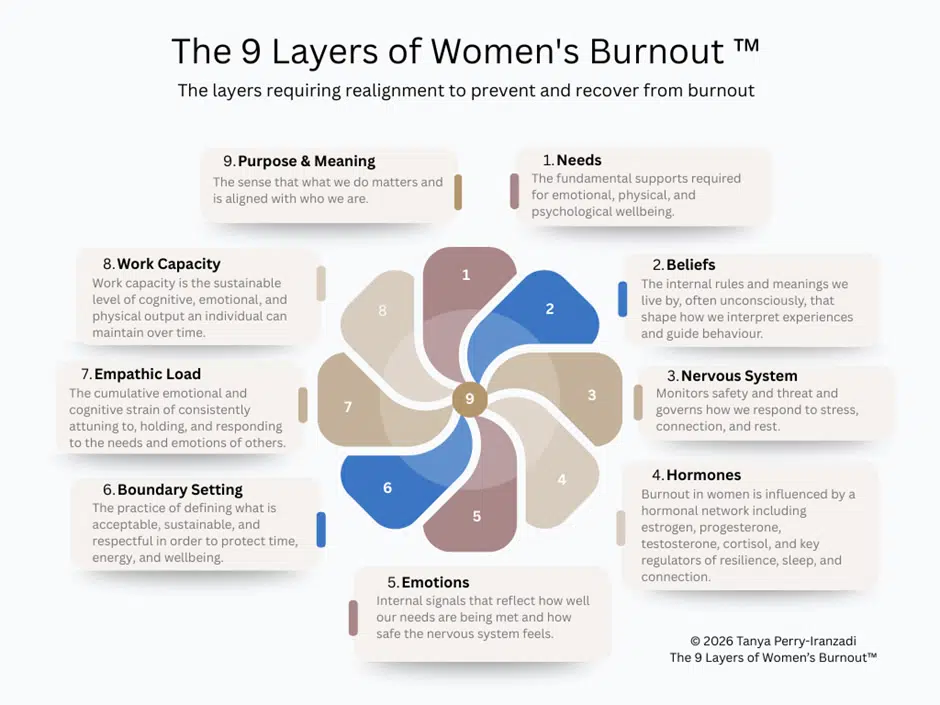
Introducing the 9 Layers of Women’s Burnout™
To name what I was seeing both in myself and in the women I now work with I developed The 9 Layers of Women’s Burnout™.
This framework recognises burnout as a system-level condition that develops through cumulative misalignment, not a single breaking point. The outer layers describe where misalignment builds. The centre reflects what restores coherence, motivation, and energy.
Over the coming weeks, I’ll explore each of these layers in depth.
The 9 Layers
- Needs How core needs for safety, connection, and autonomy are unmet, exhaustion follows.
- Beliefs The internal rules and stories that keep us over-functioning long after capacity is exceeded.
- Nervous System Why chronic activation, not workload alone, is what tips women into burnout.
- Hormones The hormone shifts that quietly undermine energy, mood, sleep, and stress tolerance.
- Emotions What emotional overwhelm, numbness, or reactivity is actually signalling before burnout takes hold.
- Boundary Setting Why boundary erosion is both a symptom and cause of burnout, not a personal weakness.
- Empathic Load When caring, supporting, and holding others becomes an invisible drain.
- Work Capacity The mismatch between expected output and real sustainable capacity.
- Purpose & Meaning (Centre) Why recovery isn’t just rest, it’s reconnection to what matters to us and our direction.

How Recovery Really Happens
Burnout recovery does not move in a straight line. It does not resolve by fixing one layer in isolation. And it is not solved by purpose alone.
Recovery occurs through intentional realignment across layers one to eight, with purpose and meaning acting as an energising force strengthening each layer rather than compensating for misalignment. This distinction matters. Because telling burned-out women to “find their why” without addressing the system that depleted them is not only ineffective it can be harmful.
Why I’m Sharing This Series
I’m sharing this series to:
- Give women language for what they are experiencing
- Move the burnout conversation beyond resilience narratives
- Support organisations to see burnout as a system-level issue
- Create more honest, sustainable pathways back to capacity and leadership
This work sits at the heart of the Journey Back to You body of work, supporting women to move out of survival mode and back into sustainable, self-led lives and careers. Follow and Join Me for this important series.
Next Article: Layer 1: Needs – Where Women’s Burnout Begins
About the retreat