
A woman once said to me, quietly: “Nothing is actually wrong… but I’m exhausted all the time.”
She was performing well at work, supporting her partner and children and sharing time with friends and family. From the outside, her life looked functional. From the inside, something was slowly eroding.
Burnout in women is often explained as a workload problem. But in my work, burnout rarely begins there.
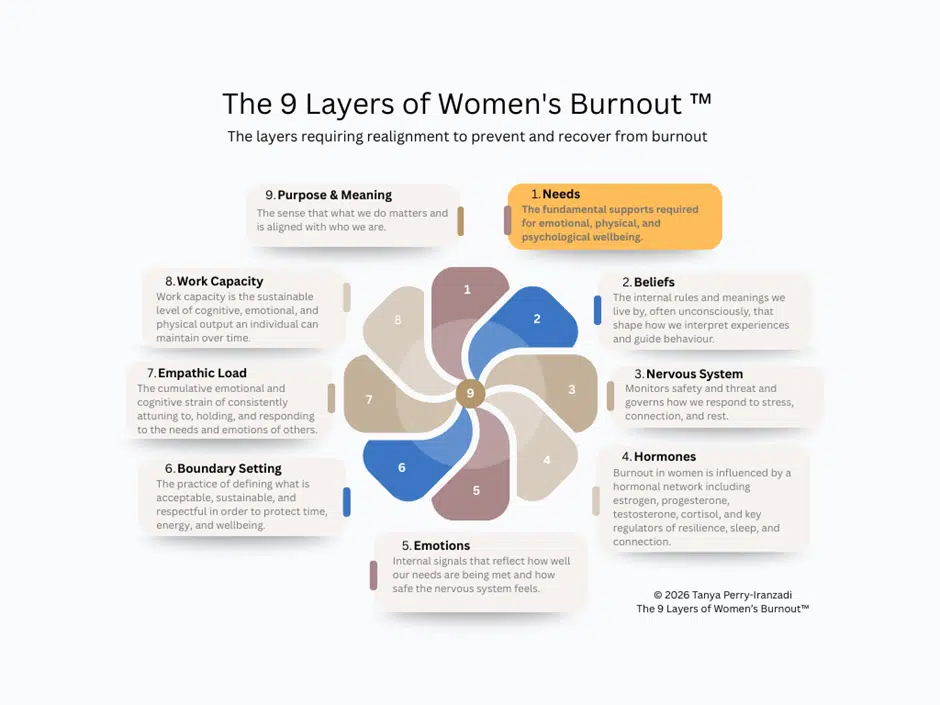
In The 9 Layers of Women’s Burnout™, it often starts much earlier — at Layer 1: Needs.
What do we mean by “Needs”?
Needs are not preferences. They are not indulgences. Needs are the baseline requirements for emotional, physical, and psychological wellbeing, the conditions that allow a woman to function, lead, and sustain herself over time.
At a foundational level, we have heard a lot about Maslow’s Hierarchy of Needs. Women’s needs include rest and recovery, emotional safety, nourishment and self-care, autonomy, connection and belonging, and time to integrate experience. When these needs are treated as negotiable, the system compensates, often long before burnout becomes visible.
When this layer is supported, the system is resilient. When it is compromised, the system adapts, often quietly, until it can no longer do so.

Why this layer is often overlooked
The woman I mentioned didn’t think she had a “needs problem.”
She thought she was just tired. Or busy. Or in a demanding season of life.
Many high-functioning women override their needs not because they don’t know they exist but because they’ve learned they’re inconvenient.
Women are conditioned early to:
- Push through fatigue
- Normalise emotional labour
- Prioritise others’ needs ahead of their own
- Measure worth through usefulness or output
Over time, this creates a powerful internal rule: My needs are negotiable.
Burnout at Layer 1
At this layer, unmet needs are contributing to the predictable outcome of over-functioning, adapting again and again to conditions that require more than the system can sustainably give. When needs are chronically unmet, the body and nervous system compensate. But adaptation is not sustainability.
Burnout, at Layer 1, is not asking to be fixed. It is asking for you to reconnect to your needs and reprioritise them.
Why awareness alone isn’t enough
The woman I mentioned already knew she was tired. She didn’t need another productivity tool or mindset shift.
What she lacked was structured language to understand what her system was signalling, and a framework that connected needs to capacity, boundaries, and leadership. This is why surface-level solutions rarely hold.
Unmet needs don’t disappear; they go underground, where they begin to shape capacity, mood, and behaviour.
If burnout were not a personal failing, but a signal, what might this layer be asking for right now?
The wider system
In The 9 Layers of Women’s Burnout™, Needs are the foundation. Each layer builds on the one beneath it, which is why addressing burnout in isolation without understanding the system rarely creates lasting change.
About the retreat